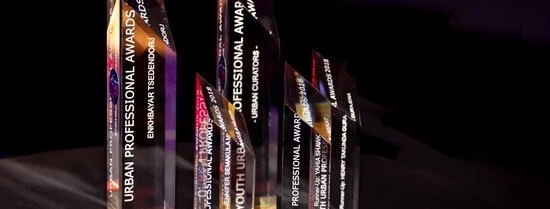
IHS Alumni Impact Award
The award aims to showcase and support worldwide initiatives and projects of IHS alumni that impact the local community. It is a celebration of city changers and inspiring urban initiatives.
Meet the Jury of the IHS Alumni Impact Award
Shyam Khandekar, Julie Greenwalt, Blake Robinson and Jammy Zhu form this year's expert jury.
See the participants below.
1. Tony Lopez, USA
Urban Strat is a personal Southern California initiative that builds social capital and lowers barriers to planning knowledge, mobility, and professional networks for communities most often left out of urban decision-making. It bridges three audiences that rarely meet directly: residents of historically underinvested neighborhoods in Los Angeles County and the Inland Empire, students from community colleges and universities entering the planning profession, and the agencies and non-profits that shape the built environment. The initiative pursues three goals:
1) Expand access to safe, equitable active transportation and mobility infrastructure in priority communities.
2) Build a pipeline of early-career planners from underrepresented backgrounds through mentorship, career resources, and professional recognition.
3) Translate technical planning, climate, and environmental policy knowledge into accessible learning experiences for students from high school through graduate school.
2. Julien Nsanzimana, Rwanda
The goal of the “Green Our Cities: Pocket Parks for People and Climate Resilience” initiative is to enhance urban resilience, inclusivity, and livability in Rwanda’s cities by transforming underutilized public land into accessible, community-friendly green spaces that provide social, environmental, and economic benefits.
- Site Identification and Selection – Identify and verify suitable government-owned land for pocket park development.
- Community Mobilization and Participation – Engage local communities to ensure inclusive and responsive park planning.
- Co-design and Planning of Pocket Parks – Develop climate-resilient, multifunctional park designs with communities and stakeholders.
- Site Preparation and Construction – Prepare sites and construct pocket parks with essential amenities and green infrastructure.
- Environmental Restoration and Greening – Restore urban ecosystems through native planting and sustainable landscape solutions.
- Partnership and Resource Mobilization – Build partnerships to secure financial, technical, and community support.
- Community Activation and Economic Empowerment – Promote local livelihoods, environmental awareness, and community use of the parks.
- Monitoring, Evaluation, and Learning – Assess project outcomes and capture lessons to support future scaling.
3. Muhammad Khizer Afzaal Chaudhary, Pakistan
Punjab, Pakistan’s largest province, is home to millions of young people in a country where nearly 60% of the population is under the age of 30. Despite the availability of public sports infrastructure, many young people—particularly women, girls, and youth from underserved urban communities—face barriers to accessing safe, inclusive, and affordable opportunities for recreation, participation, and personal development. Many public sports facilities also remain underutilized, limiting their potential to serve as vibrant community assets that foster social interaction, wellbeing, and community cohesion. The Urban Youth Sports Inclusion Initiative was established to address these challenges by transforming public sports facilities into inclusive, accessible, and community-oriented spaces that promote participation, wellbeing, and social inclusion. Its goal is to strengthen the role of public sports infrastructure as a platform for youth development, healthy lifestyles, gender inclusion, and community engagement while contributing to more inclusive, resilient, and sustainable communities in line with SDG 11.
Implemented through a network of more than 600 public sports facilities serving cities and communities across Punjab, the initiative creates opportunities for community-level engagement while ensuring broad access and impact. Its key activities include expanding access to sports and recreation for women, girls, and underserved youth; supporting athlete development through scholarships, stipends, training opportunities, and participation support; organizing community-based sporting events and competitions; strengthening partnerships with local stakeholders; and promoting the effective utilization of public infrastructure for social inclusion and community wellbeing.
A key feature of the initiative is the establishment of sustainable financing mechanisms, including Pakistan’s first provincial Sports Endowment Fund, which helps ensure long-term access to opportunities for young people while maximizing the social value of public sports infrastructure. Through these efforts, the initiative leverages sports as a tool for inclusion, empowerment, and community development, enabling public spaces to become more active, accessible, and beneficial for the communities they serve.
4. Diona (Deyao) Shen, The Netherlands/China
The initiative brings the global Jane's Walk methodology — community-led, pedestrian-scale urban exploration inspired by Jane Jacobs — to Chinese cities. It aims to build urban literacy, foster inclusive participation in heritage conservation and urban planning, and connect residents, heritage professionals, and urban planners through shared walking and dialogue. A parallel goal is knowledge codification: creating replicable toolkits that enable other facilitators to run similar programmes with minimal resources. Two complementary pathways: Breadth (national, via Citipedia): 1–2 themed city walks per year per city, expanded from Shanghai (2019) to 10+ cities including Hangzhou, Shenzhen, Guangzhou, Tianjin, Nanjing, Beijing, Suzhou, Changsha, and Hong Kong. Themes range across public space planning, urban nature (NBS), regeneration and gentrification, inclusive and accessible streets etc. Each event pairs a guided walk with a participatory mapping workshop.
Depth (Hangzhou, via West Lake Ambassador Programme): 3–4 focused events per year centred on Hangzhou's UNESCO World Heritage landscape — West Lake and the Grand Canal. Activities explore the relationship between heritage conservation, urban governance, and living communities, using walk routes, identity task cards, and co-creation mapping. Outcomes from workshops are documented and shared with heritage managers and urban planning agencies as community input. Core activity format: Walk in the neighbourhood: A planning team (typically 4–8 people) designs 1–3 thematic routes within an urban area. Participants (10–15 per route, 1.5–2 hrs) are guided through using task cards that prompt multi-sensory observation and conversations with local residents encountered along the way. Workshop: Participants from all routes reconvene for a participatory mapping workshop, co-creating a collective 'neighbourhood image map' to share their observations, discuss heritage change, and propose ideas for more inclusive urban development. Workshop outputs are fed back to relevant planning and heritage management bodies. Such events activated a wide network with local partners. For instance, the Hangzhou series were supported by the Hangzhou Urban Planning and Design Institute, Hangzhou Museum, Zhejiang University, Zhejiang University of Technology, the Grand Canal Heritage Management Centre, and multiple community offices.
5. Stephanie van Heijningen, Curaçao
The goal of the project - officially titled “Swaen. Samen Werken aan een Waardige Leefomgeving”/"Swaen. Building a Worthy Living Environment Together", is to serve as a pilot project and model for urban renewal in Curaçao and other postcolonial urban contexts in the Caribbean region. The main activities focus on an integrated, area-based approach that combines heritage preservation, social development, circular construction practices, climate-conscious spatial planning, and participatory design. This will be done by the means of workshops, 'townhall' meetings, co-design sessions and further research. The project also includes practical capacity building by providing on-the-job training for students (form the University of Curaçao as well as TU Delft and De Haagse Hogeschool) through so-called 'Learning Communities' enabling them to apply these skills to future urban development challenges.
6. Ebrahim Oliya, Iran
7. Nora Yunes Elafifi, Egypt
- driven by Aswan’s youth and powered by the community -
Goals:
- Position the initiative as an influential development narrative for Aswan Governorate to show that simple, visible, and community-driven solutions can improve urban liveability and combat extreme heat.
- Build strong public trust and acceptance prior to physical installation, focusing heavily on immediate residents and local shopkeepers.
- Establish Aswan Governorate’s role as a proactive leader in urban climate adaptation.
- Present the “Aswan Is More Beautiful with Its Youth” cohort as the primary leaders in physical execution and spatial management.
- Produce robust media assets, including before/after visual tracking, short documentaries, stakeholder interviews, and an official launch film to document the transformation.
- Secure localized corporate social responsibility (CSR) sponsorships from solar providers, construction suppliers, and artisans.
- Anchoring the project to verifiable outcomes, such as reduced ambient temperatures, increased public space usage, and higher resident satisfaction.
- Transform the project into a validated urban climate adaptation case study to be shared with international universities and development organizations.
Activities:
- Running interactive sessions with children to map out murals, focus groups with women and the elderly to locate seating, and technical workshops with youth to place trees and technology.
- Clearing neglected urban spaces and implementing “urban acupuncture” small, cost-effective, and rapid physical improvements rather than massive infrastructure projects.
- Planting native, low-water flora (such as date palms and acacias), creating shade canopies, and installing permeable paving to lower asphalt heat emissions.
- Installing temperature, humidity, and air quality sensors alongside interactive QR codes, all connected to the digital “Aswan Smart Eye” platform.
- Building modular seating and crafting localized murals using palm fronds, sandstone, geometric motifs, and warm regional colors.
- Mounting standalone solar-powered lighting units to improve street safety and enable night-time utilization. • Photographing precise before/after camera angles and analysing environmental sensors to measure exact microclimatic changes and space usage.
- Training local youth teams in ongoing spatial asset management, preventive maintenance, and continuous digital data tracking.
8. Kelly Arendse, South Africa
The Local Planning Support responds to Cape Town’s wider affordable rental ecosystem. It works across sectors and City departments to unlock affordable rental flats, unblock delivery barriers and support homeowners, micro-developers, township developers and built environment professionals. It provides professional, technical and administrative process support through outreach sessions, district office engagements, community forums and direct guidance. Its objectives are to: - Enable new affordable rental flats. - Regularise existing rental stock. - Support the affordable rental ecosystem across sectors. - Unblock planning, building-control, infrastructure and development-charge barriers. - Improve project turnaround times. - Capacitate built environment professionals. - Guide sustainable neighbourhood densification. - Help historically marginalised households build income, assets and wealth through rental property.
9. Tudor Racoviceanu, Romania
The initiative aims at supporting the public and private actors in Pipera North Business District to improve the quality of the working environment and to develop the area in a SMART way. For this reason, the following objectives are envisaged:
Phase 1:
• to discuss ‘SMART mobility’ in the business district. The area is a fast-developing modern business district, and every day thousands of people travel to/from work. Mobility is an issue in the area, and the event launched a first debate among stakeholders, on their potential role in improving the current situation.
Phase 2:
• monitor changes in the users’ demand, by recording their opinions on the recent development stage;
• raise awareness on SMART development aspects – opportunities and challenges for the involvement of local actors;
• generate a constructive dialogue on expectations, initiatives and development plans, on opportunities for the area SMART development;
• support the formulation of SMART local initiatives as a basis for an action plan proposal.
In phase 1, in the weeks leading up to the debate, an online questionnaire was made, addressing the neighboring companies and their employees. Its goal was to assess their awareness regarding the urban mobility plans of the neighborhood, get an indication of the priority needs in the area, and suggestions of concrete improvements. The reaction was important: almost 500 (exactly 498) respondents gave their feedback and provided input for the debate. 77 participants attended the event. In phase 2, a series of interviews addressed representatives of companies located in the area, willing to share their opinions, as Pipera’s users. Presentations of case studies experiences with smart cities in Europe were prepared and recent developments in the area were documented as well.
10. Charles Wood, USA
The goals for Stronger Denton are to encourage sustainable development within the city of Denton. Sustainability as a metric is defined as economic sustainability, incremental development, multi-modal transportation, and health and safety.
Stronger Denton serves as a local cell of the National Strong Towns movement that focuses on bringing communities together to create solutions to tackle the future fiscal and community issues caused by urban sprawl. The main activities are focused on advocacy for sustainable developments by providing education on the state of the city through our monthly meetups, assisting members in getting elected/appointed to local boards, and creating events that provide a proof of concept for the future we are working towards. Through advocacy activities, we were instrumental in bringing about land reform that enabled more affordable housing options in Denton, such as townhomes and accessory dwelling units (ADUs). The Denton code had conflicting language on ADU placement and held certain requirements that prevented townhomes from being built. Our founder highlighted these codes, and our group invited keynote speakers to present to the City Council about the concept of missing middle housing and how these codes exacerbate the issues. Following 2 workshops and an extensive survey, the reform was presented to the City Council. Despite some opposition, our group mobilized and attended in overwhelming numbers to support the reforms. The reforms were passed, and it has since allowed for developers to bring more affordable housing options.
An example of Stronger Denton creating events includes our recent pop-up market in the neighborhood of North Lakes. The main purpose of the event was to highlight the importance of having small commercial activity within a neighborhood. The pop-up market attracted local artisans, bakers, and baristas. This provided an opportunity for micro-businesses, and its proximity to houses allowed neighbors to walk and bike to the market. The event mixed local economic activity with multi-model transportation, which assists us in encouraging future developments to incorporate ideas like these events.
Looking ahead, our main activity this year is to eliminate parking mandates in Denton. To help advocate for this, we have been preparing for a national event, Parking Day, to highlight how much space is used for parking and advocate for alternative, more equitable uses. For Parking Day, we seek to host an event where we create small uses on existing parking lots that can include a micro park confined to a parking space, or an art installation, or even tabled seating for local businesses. Parking Day visualizes what a community can become through efficient land use and will serve as effective advocacy.
11. Tannya Pico Parra, The Netherlands/Ecuador
Our group, Pacha Ayllu, is a collective of parents, grandparents, aunts, and uncles united for a better world for our children and all children in Ecuador. We are part of the global community of Our Kids’ Climate (OCK) and participate in the OKC Clean Air Working Group. Over the past years, we have organized several activities, such as workshops, lectures, and panels, to highlight the significance of clean air. As we are a family-led grassroots organization, we are convinced that the love for our children is the strongest drive for a real change.
Goals and Main Activities:
Our mission is to empower families to act as guardians of their local air quality.
• Actionable Knowledge:
We translate technical air quality data (which shows pollution in Quito is 3x higher than WHO recommendations) into practical tools for families to protect children and vulnerable groups.
• Strategic Activities:
We conduct Clean Air Workshops using interactive dice games and creative storytelling to teach adaptive behaviors like adjusting outdoor play or closing windows during peak pollution.
• Collaborative Monitoring:
We partner with families to host low-cost AirGradient sensors, using them as "participatory learning tools" rather than just static devices.
12. Fredrick Onyango Warega and Rex Otieno Omondi, Kenya
The main goal of the initiative was to prepare a climate-resilient, inclusive, and people-centred Local Physical and Land Use Development Plan for Homa Bay Municipality, known as the "People’s Adaptation – Local Physical and Land Use Development Plan for Homa Bay Municipality, 2025–2035". The project was one of a kind in Kenya because it brought together statutory urban planning and deep community-led adaptation planning. It did not treat residents as passive beneficiaries. Instead, communities were engaged as co-creators of the plan through household enumeration, mapping, consultation, validation, and prioritisation of climate adaptation needs. The process targeted full household enumeration and used community-generated evidence to make vulnerable settlements visible in formal planning. The initiative aimed to respond to the real conditions facing Homa Bay Municipality, including climate risks, flooding, drought, underutilized blue economy, poor drainage, inadequate water and sanitation, settlement vulnerability, insecure housing conditions, land use pressures, environmental degradation, and gaps in basic infrastructure. It sought to translate these realities into a formal planning framework that can guide future development, public investment, and climate adaptation action. The process also benefited from support by the Global Center on Adaptation, which helped strengthen the climate adaptation framing, technical learning, and wider visibility of the People’s Adaptation Planning approach. GCA’s support helped connect the Homa Bay experience to broader conversations on locally led adaptation, urban resilience, and climate-responsive planning.
The main activities included:
- Establishing a partnership between the County Government of Homa Bay, AMT, communities, and other technical and development partners.
- Supporting a statutory planning process for Homa Bay Municipality through the Local Physical and Land Use Development Plan framework.
- Training community youth and local actors to support household mapping, numbering, enumeration, and data collection using digital and geospatial tools.
- Undertaking large-scale household enumeration and settlement mapping to generate detailed evidence on socioeconomic conditions, service access, infrastructure gaps, climate vulnerability, and household-level risks.
- Conducting deep community consultations where residents identified climate risks, development challenges, vulnerable hotspots, and priority adaptation actions.
- Validating findings with community representatives, county officials, NGOs, technical experts, and local institutions.
- Integrating community evidence with technical analysis, climate risk assessment, land use planning, infrastructure planning, housing concerns, and environmental priorities.
- Co-creating a plan that places vulnerable communities, including women, youth, and residents of informal settlements, at the centre of climate-resilient urban development.
- Supporting the formal adoption of the plan as a planning framework to guide future investments in Homa Bay Municipality.
13. Oleksandra Tkachenko, Ukraine/The Netherlands
Mission: We believe in a sustainable, inclusive and resilient Ukraine as a driving force for transition within the EU.
Vision: UNUN aims to facilitate a bilateral exchange of knowledge and foster long-term connections between Ukrainian cities and urban professionals (both Ukrainian and Dutch).
Strategy: - To grow and maintain a strong professional network by organizing networking events and facilitating direct relevant contacts - build capacity through lectures, books donations, online courses, workshops and webinars - inspire innovative ideas through a think tank.
14. Cornelio Jr. M. Ramirez, Philippines
Goals of the Project:
1. Enhanced forest cover through reforestation of critical watersheds;
2. Reduced disaster risk and urban flooding of urban areas of the Municipality of Alabel, Sarangani Province;
3. Improved and sustainable supply of water to urban areas;
4. Improved biodiversity and wildlife;
5. Accessed to safe and potable water to every household in urban areas.
Main Activities of the Project:
1. Planting/growing of native trees and fruit bearing trees in Calminda and Bialong watersheds in Barangay Paraiso and Bagacay, Alabel, Sarangani Province;
2. Engagement of stakeholders/partners in project implementation;
3. Water potability monitoring of groundwater sources; and
4. Capability building and technical training for beneficiaries.
15. Juliet Chinemelu, Nigeria
Home4Her Africa aims to transform how African cities plan, finance, and deliver affordable housing for vulnerable women by advancing gender-responsive, climate-resilient, and people-centred urban development. The initiative focuses on improving housing security, social protection, and economic inclusion for low-income women, widows, single mothers, female-headed households, and women living in informal settlements, while contributing to more inclusive and resilient cities. The initiative's flagship innovation is the Safe Housing Zone (SHZ) Model—a people-centred urban housing model inspired by the UN-Habitat People-Centred Smart Cities approach. The model integrates affordable housing with climate resilience, sustainable land use, accessible mobility, green infrastructure, digital innovation, and essential social services to create safe, inclusive, and sustainable communities. Home4Her Africa's main activities include developing and promoting evidence-based housing policies, conducting research and stakeholder consultations, building partnerships with governments, communities, academia, the private sector, and development partners, mobilising resources for affordable housing initiatives, and supporting the adoption of the SHZ Model as a scalable solution for improving housing security and urban resilience across African cities.