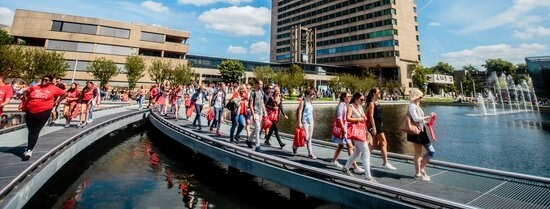
Cities are changing fast, but each city changes in its own unique way. Housing, climate, infrastructure, inequality, land, finance and technology all shape each other, and what works in one place may not work in another. Traditional divides between urban planning, policy, and development no longer suffice to address the crises facing our cities today. At IHS, we are moving beyond these conventional disciplinary boundaries. We introduce you to the MSc in Global Urban Change, formerly known as Urban Management and Development.

What stands behind Global Urban Change
Future urban professionals cannot rely on ready-made solutions. You need to understand how different urban problems connect on the ground, how to connect the stakeholders who can make positive impact, and how to turn ideas into actions that make cities more resilient, sustainable and prosperous. To capture this dynamic reality, our master's programme in Urban Management and Development has transitioned to a new name: Global Urban Change.
We recognise that today’s world is multipolar; whether a city is in Europe, Asia, or Africa, the challenges of affordable housing, social justice, and climate resilience are universally experienced but in unique contexts. In the IHS classroom, students move beyond the conventional teacher-student dynamic to build a model of mutual learning, where every person from every city has something to teach and something to learn.
You don’t just study what a city is; you investigate how it changes.
Participants will explore integrated, sustainable approaches - from harnessing nature-based solutions to navigating the complexities of a circular economy and managing vital resource flows like water and air. They will also look at social, economic, and technological forces shaping cities – from reviewing key housing and land approaches to examining innovation as a central driver of growth and exploring financialisation processes influencing urban life.
What does it mean for you?
Whether you are a prospective student, an active applicant, or an alumnus/a, your application and degree recognition remain unaffected. To find out more about how the transition impacts your specific status, visit our dedicated Global Urban Change FAQ page.
A new way to learn: your path, your choice
To match the dynamic nature of the field, the programme was redesigned with a new year structure. Emphasising modularity and enhanced flexibility, the curriculum empowers students to tailor their academic journey to their unique career ambitions and interests. We address that urban challenges are interconnected - a climate expert needs to understand social justice, and a digital innovator needs to understand land policy. That is why the academic year is now designed to move you from foundational knowledge to a specialised learning experience. The core of the programme’s new structure is the tailored learning trajectory.
While the core courses establish a solid foundation in key debates, urban complexity, resilience strategies, and methodology skills, the specialisation courses offer students the freedom to pick from a range of deepening modules. Whether you are interested in digital transformation, water management, or social inequality, you can select the specific modules that will make the most impact on your future career. The academic year concludes with a dedicated thesis period, where students apply their knowledge to original research.
| Phase | Focus | What happens? |
|---|---|---|
| Core courses | Foundations | You master the essentials: introduction to urban theories and debates, urban complexity and research methods |
| Specialisation modules | Personalisation | This is where you take the lead. You can pick deepening modules to build a learning path that fits your specific goals. |
| Thesis | Application | You dedicate your final months to your thesis research, supported by IHS supervisors. |
Cities are not one-dimensional, and neither should be the education of those who lead them. By allowing students to select courses that resonate with their personal interests, we are enabling them to build a unique professional profile that meets the specific needs of their home countries or future employers.
Choose your specialisation path
While the programme offers flexibility, it remains anchored by two primary specialisations designed to tackle the most pressing urban issues of the 21st century.

Urban Socio-Spatial Transformations
The Urban Socio-Spatial Transformations specialisation is designed for those eager to understand the social, economic, and technological forces shaping modern cities. It focuses on urban inequalities, the digitalisation of "smart" cities, and the dynamics of land and housing policies. Graduates from this track emerge ready to design inclusive, socially just, and innovative urban interventions.

Urban Environment and Climate Change
The Urban Environment and Climate Change specialisation explores how cities can become truly resilient by looking at the bigger picture. Students explore integrated approaches such as circular economy, climate justice, nature-based solutions, and sustainable housing. The track prepares professionals to manage complex risks related to water, resources, and climate resilience to build carbon-neutral cities.
From theory to global impact
Our alumni don't just study cities - they shape them. IHS alumni data shows the success of this practical approach: nearly 75% of graduates enter full-time roles immediately, with 50% working in the public sector and others shaping cities through NGOs, start-ups, and international organisations like UN-Habitat.
Studying in Rotterdam means joining a diverse classroom where case studies come from every corner of the globe. The city itself serves as your living laboratory - a vibrant, innovative hub that is constantly reinventing itself, much like the students we welcome every year. By joining us, you aren’t just learning to navigate urban transformations; you are gaining the cross-disciplinary skills to navigate and shape the global forces that define our collective urban future. You are becoming a changemaker, equipped to lead the transition toward truly sustainable, resilient, and equitable cities for all.
- Related education
- Related links
- MSc Global Urban Change | Frequently Asked Questions