Urban change rarely begins at the scale of a city. More often, it starts with an idea of a handful of people determined to make a difference in their tight-knit community. With time, collaboration, resources and the right connections, these efforts can grow into initiatives that make a great impact on the inhabitants of a city.
This is the kind of impact we see year after year in countries across the globe through the IHS Alumni community, and the kind of change IHS supports through the IHS Alumni Impact Award. This edition of the award was no exception, with 15 participants from 14 countries, all worthy of recognition for their projects that make meaningful change possible in their cities.
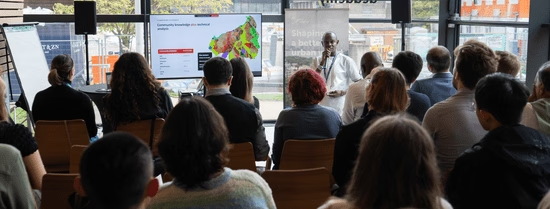
After the award closing event which took place on October 9 in Rotterdam, we look back at all the finalists with great appreciation for their commitment to make a difference in their communities. The event brought together alumni, students, staff, and urban professionals in Rotterdam. Combining an interactive workshop, an award ceremony and networking, the event celebrated the work of IHS alumni who are turning urban development knowledge into meaningful action in their communities.
Lessons on community involvement
Under the theme “Moving the needle: from community participation to urban change”, the event explored an important question: how can community participation create real change? The afternoon started with presentations from each of the finalists.
From Tannya Pico Parra and her initiative in Ecuador, "Pacha Ayllu/Families of Nature", we learned that meaningful urban change can start at home. By bringing families into conversations about air quality, Tannya's initiative shows how complex environmental information can be turned into practical knowledge and everyday action to protect the most vulnerable citizens. Her work reminds us that people do not need to be urban planning experts to become agents of change. Through accessible learning, community participation and simple tools such as low-cost air-quality sensors, families can better understand environmental risks and take action.


From Muhammad Khizer Afzaal Chaudhary and his "Urban Youth Sports Inclusion Initiative" in Punjab, Pakistan, we learned that urban change begins with making existing public spaces accessible to everyone. By opening up sports facilities to underprivileged youth, especially young girls and low-income athletes, his initiative works to overcome social and financial barriers and ensure that public resources serve the whole community and create a sense of belonging.
His work reminds us that urban infrastructure is less about the physical assets, and more about making public spaces inclusive, accessible, sustainable and resilient for the communities they were meant to serve.
From Fredrick Onyango Warega and Rex Otieno Omondi and their initiative "People’s Adaptation – Local Physical and Land Use Development Plan for Homa Bay Municipality 2025–2035", we learned that meaningful urban planning starts by listening to the people who know their communities best. By bringing residents’ voices, local knowledge and lived experiences into planning processes, their initiative helps shape a more inclusive and climate-resilient future for Homa Bay.
Their work reminds us that community participation is most powerful when it goes beyond consultation and helps shape real decisions. By connecting residents’ everyday experiences with technical analysis and embedding that into formal planning processes, they show how local voices can influence long-term urban development and help build a more resilient future for the residents.


The presentations were followed by an interactive workshop on community participation, led by Dr Pamela Durán-Díaz, Senior Planning Specialist and lecturer at IHS. The discussion delved deeper into the three community-centred finalist projects and the participants worked in groups to identify solutions for existing gaps in each initiative. The finalists demonstrated different ways of putting participation into practice, from involving residents in formal planning processes, to empowering families to monitor air quality and protect the most vulnerable, and making public spaces more inclusive for underprivileged youth.
The winning initiative
The workshop was followed by the Award Ceremony, where the Jury representative, IHS alumnus and long-term partner Shyam Khandekar, announced the winning initiative: People’s Adaptation – Local Physical and Land Use Development Plan for Homa Bay Municipality 2025–2035 by Fredrick Onyango Warega and Rex Otieno Omondi, from Kenya.
We warmly congratulate our alumni duo for their tireless work and we look back with a deep sense of appreciation and inspiration for this powerful example of what strategic collaboration within the IHS Alumni network can achieve. Fredrick and Rex are IHS alumni from different graduating batches, who joined forces for this project in Homa Bay, Kenya. Bringing together experience from the public sector and the civil society, with its close connections to the local informal communities, they bridge institutions and local realities, connecting formal planning processes with the voices and knowledge of residents. Their collaboration shows that the value of an alumni network lies not only in shared educational experiences, but also in offering a fertile ground for partnerships to emerge and see what can happen when people with different perspectives, professional roles and connections work towards a common goal.
Lasting urban change starts with people who care — and gains momentum when they connect, collaborate and bring others along.
While the award recognises one winning initiative, together, all the initiatives from the IHS Alumni Impact Award demonstrate the value of locally driven approaches and the importance of creating opportunities for communities to influence the places in which they live. The event concluded with networking, bringing participants together to exchange experiences and strengthen connections within the IHS community.
For IHS, the Alumni Impact Award is an opportunity not only to celebrate alumni achievements, but also to learn from their experiences and share the practical knowledge emerging from their work around the world.
Congratulations to the winners and the finalists of the IHS Alumni Impact Award 2026!


