| Themes | advisory, training needs assessment, urban and local planning |
|---|---|
| Client | SWECO |
| Counterpart Organisation(s) | Local partner |
| Duration | TBA |
| Countries | Saudi Arabia |
| IHS Contact | TBA |
More about the project
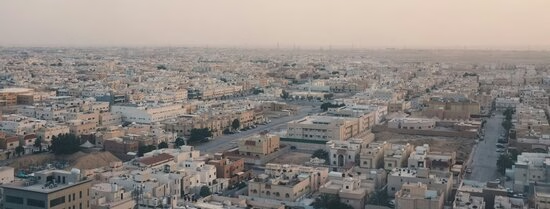
IHS provided training needs assessment input with focus area on evaluation on existing capacity, technical and institutional assessment, best practices, action plans, training, and knowledge transfer. The project aimed to formalise and apply government's vision and strategic direction through a regional plan, with greater detail to be provided in Local Plans for each Governorate, to provide the spatial direction and regulation, along with an Urban Code (separate project) to guide the built form for the Region, across all Governorates, focusing on Sakaka and the key settlements, which are cities/towns over 25,000 and Governorate capitals.
The overall national project aimed to put in place a Regional Plan with subsidiary Local Plans for each of the governorates that:
- Addresses the entire Al Jouf region, its governorates, and key settlements, across urban, rural, and environmental areas
- Aligns, interprets, and applies national objectives and goals
- Contributes to the establishment of a more predictable and reliable development framework, providing direction, integration, and coordination across all stakeholders, including, for example, those that have some form of regulatory responsibilities
- Reconciles the regions’ and governorates’ social, cultural, environmental and economic vision and priorities, ensuring sustainable, resilient outcomes adapted to climate change, with a constantly improving quality of life, building on the regional development strategy and supporting the regional development initiatives,
- Puts in place key regulations and guidance that ensure that the region, Sakaka and the governorates and their settlements has a basis on which development/building permits can be issued and enforced
- Becomes the basis for Urban Codes
- Provides a focus on the continuity of the unique identity of the region/place, arising from the local traditional/vernacular, informing the quality outcomes for built form, and the public realm
- Identifies the catalytic projects and their recommended targets and parameters (as well as prioritize the short and medium-term strategic policy and investment requirements