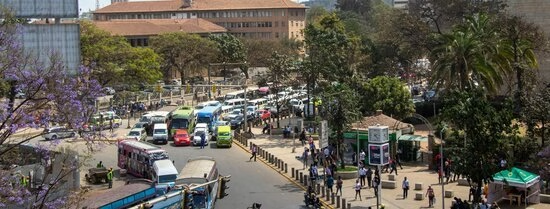
What happens when you take classroom theory and apply it to one of the world’s most dynamic urban environments? For Ahmed Mouhsen, a student in the MSc in Urban Management and Development at IHS, it meant swapping Rotterdam for Nairobi to conduct impactful thesis fieldwork.

Connecting climate theory and reality
Originally from Iraq, Ahmed came to IHS with a background in architecture and the humanitarian sector. While specialising in urban environment and climate change, a course on Urban Complexity sparked his fascination with informal settlements and challenged his assumptions about urban resilience. When the opportunity arose to conduct his thesis fieldwork abroad, he didn't hesitate to travel to Nairobi with two fellow students.
Ahmed’s research investigates how communities navigate environmental risks through nature-based solutions, looking closely at how different actors (such as communities, NGOs, and public institutions) work together to support their implementation and long-term sustainability in informal settlements.
By stepping out of the classroom, he interviewed residents, practitioners, and local authorities to analyse how governance arrangements and community action intersect on the ground. This emphasis on independent, high-impact field research allows students to transition from analysing global urban challenges to actively investigating them in the communities where they unfold.
"Behind every dataset, map, or policy discussion are real people with their own stories, aspirations, and lived experiences."

Spotlight on grassroots innovation
While in the settlement of Kibera, one of the key initiatives Ahmed studied during his fieldwork was Community Mappers, a grassroots initiative founded by local advocate Nicera. She started the organisation after attending a conference where she realised that external narratives and data did not accurately reflect her community's reality. Today, the group trains young women and single mothers in data collection, digital mapping, and photography, ensuring local knowledge and lived experiences are accurately represented in decision-making processes.
During his fieldwork, Ahmed observed how the group tackles localised flooding. Recognising that textile waste was clogging drainage systems, the initiative began collecting discarded fabrics and upcycling them into bags, simultaneously solving an environmental hazard and creating new jobs for the community.
"Resilience is not just an academic concept or a policy objective. It is something people practice every day."
The initiative mirrors the core focus of the curriculum: exploring inclusive urban governance and recognising that effective climate adaptation relies heavily on local knowledge and community leadership.
The power of context-driven solutions
The project left such an impression on Ahmed that he couldn't leave without purchasing a few of the upcycled bags himself. Ultimately, Ahmed hopes his thesis will help international practitioners design more sustainable urban interventions by prioritising long-term local ownership rather than short-term metrics.
Reflecting on his journey, he notes that the experience pushed him to become a better researcher by questioning his own assumptions. His story highlights the deeper purpose of the master's programme: equipping global urban professionals with the critical tools needed to listen to local voices, adapt to complex contexts, and help shape truly resilient, inclusive cities.
"Effective solutions cannot simply be copied and pasted from one place to another."
- Related content
- Related education


