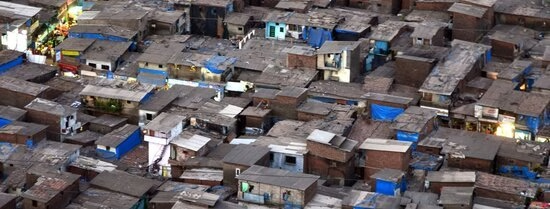
As IHS gets ready for the 13th World Urban Forum (WUF13) in Baku, we reflect on factors that are currently shaping urban change. Effective and inclusive actions at the local level, supported by global and multilevel efforts, will be crucial in achieving our shared sustainable development goals. This can only be accomplished by prioritising housing as the foundation for safe and resilient communities.
"Adequate housing is a cornerstone of human dignity”
This was the clear message issued in July 2025 by Anar Guliyev, on behalf of the Republic of Azerbaijan, during the High-Level Dialogue on Adequate Housing for All at the United Nations Headquarters in New York. Beneath this seemingly simple phrase lies a myriad of complex and interlocking pathways that can either shape a collective and just response to achieve this human right or leave us in the realms of discourse and aspiration. In today's strained geopolitical context, ensuring we can act with rigorous knowledge to underpin the necessary political will is more critical than ever.
The WUF13 takes place at a time of great urgency. Since the forum's last edition in Cairo two years ago, multiple global crises have accelerated, with profoundly urban consequences. Wars are destroying housing and civilian infrastructure in Gaza, Lebanon, Myanmar, Sudan and Ukraine, and other regions, at unprecedented scales [1]. In Gaza, 92% of homes have been destroyed or severely damaged [2], resulting in the emergent framework of "urbicide” to analyse the systematic erasure of the built environment and the social life it sustains as a key tool of settler-colonial governance [3]. The ongoing escalation and regionalisation of conflict in the Middle East has plunged the world into an acute, global energy crisis. Whether it is Keke Napep drivers in Nigerian informal settlements, migrant workers in the kitchens of South Asian mega-cities, or blue-collar workers at the petrol station in American suburbs, it is the poorest and most vulnerable who are the first to suffer.
Across these global dynamics, housing stands out as the foundational system through which dignity, resilience, and inclusion in cities are ultimately realised.
Navigating social instability and climate risk

Across the world, overlapping social, economic, and environmental crises have simultaneously found expression in waves of youth led protests. From movements in Nepal demanding political accountability [4], to demonstrations in Indonesia [5], Kenya [6], Mexico [7] or Spain [8] sparked by economic pressure, housing unaffordability, climate stress, and inequality, our cities’ streets are signaling a shared global reckoning, driven by rising living costs, shrinking opportunity, worsening climate impacts, and a sense that institutions are moving too slowly.
Meanwhile, cities continue to be on the frontlines of climate disasters. Climate impacts are felt disproportionately in urban communities, with the most economically and socially marginalised, especially the more than 1 billion people [9] living in informal settlements, feeling the largest effects. Many informal settlements are ill-prepared for climate change, facing particularly high risks of floods and landslides due to poor-quality buildings and a lack of infrastructure to prevent flooding, withstand heavy storms, and cope with heat waves [10].
In 2025, floods affecting Southern Africa in 2025 resulted in loss of life, destruction of over 70,000 homes, damage to health facilities and schools, and large-scale disruption to roads in Mozambique. Wildfires in Los Angeles resulted in the destruction of close to 15 000 homes, with property damages estimated between $28.0 billion and $53.8 billion [11]. Extreme weather events also led to intensive flooding and disruption to city life worldwide, from Morocco to Indonesia. Heat is a constant threat, with recent analysis examining how 1.5°C and 3°C of global warming could reshape life in roughly 1,000 of the world’s largest cities through more frequent and prolonged heat waves, surging energy demand for cooling, and expanded conditions in which insect-borne diseases are spread [12].
Housing is where social unrest and climate risk most clearly intersect, shaping everyday exposure to insecurity, displacement, and inequality in urban life.

Living through an inherently urban century
The WUF13 takes place in a more urban world than ever before. Since the last edition, UNDESA have released their "World Urbanization Prospects", an important update of urban trends and figures globally that underscore that we are living through an inherently urban century. Today, cities are home to 45% of the world’s 8.2 billion people, more than double their share in 1950, and nearly all global population growth between now and 2050 will be absorbed by cities and towns. While megacities capture headlines, they tell only part of the story: 96% of the world’s 12,000 cities have fewer than one million residents, and many of the fastest growing are small and midsized cities in Africa and Asia. Often stretched thin on planning capacity, financial resources, and basic services, these places are at the forefront of rapid urbanisation, where the consequences of growth, and climate stress, will be felt most sharply [13].
The global housing crisis is felt across regions and reflects deep structural failures in how housing systems are planned, financed, and governed. Rising housing costs, stagnant incomes, and chronic underinvestment have pushed millions out of adequate housing, undermining social cohesion and economic stability. In both advanced and emerging markets, shortages of affordable, well-located homes exist alongside speculative investment and vacant properties, exposing systemic imbalances in land and housing markets. Compounding these pressures, new development continues to sprawl to city peripheries without adequate infrastructure or services, reinforcing spatial inequality and threatening the sustainability of urban growth [14].
In an increasingly urban world, the sustainability and equity of future growth will depend fundamentally on how housing systems are planned, financed, and governed.
Turning global agreements into local actions
The WUF13 takes place at the starting line of a particularly important chain of international events with high urban relevance [15]. Innnovate4Cities will take place in June in Nairobi, linking scientific insight, innovation, and implementation at the city level, and providing a space to review the forthcoming IPCC Special Report on Cities. This will be followed by the High-Level Political Forum on Sustainable Development (HLPF) New York in July, taking stock of progress notably towards SDG 11 and identifying solutions that could accelerate progress toward the goal of making cities and human settlements inclusive, safe, resilient and sustainable by 2030. This year also marks a rare and consequential moment for global environmental action, as all three Rio Conventions, tackling the interconnected crises of climate change, biodiversity loss, and land degradation, will convene their COPs between August and November. The climate talks in Antalya, Türkiye (COP31), the biodiversity summit (COP17) in Yerevan, Armenia, and the desertification COP in Ulaanbaatar, Mongolia (COP17), come at a time when implementation is the central challenge.
Implementation of these Multilateral Environmental Agreements (MEAs) increasingly depends on action taken at the local and regional levels. Urban areas today consume two thirds of energy and generate more than 70% of global CO2 Emissions [16]. By 2030, 40% of strictly protected areas are expected to lie within 50km of a city [17]. Meanwhile, land degradation affects nearly 40% of the world’s land area and directly impacts 3.2 billion people in both rural and urban settings [18].
Translating global environmental and development commitments into meaningful outcomes relies on housing decisions that shape land use, emissions, and social resilience at the local level.

Working together towards a just and resilient future
At WUF13, IHS will put its commitment to sustainable urban development into action through a range of sessions aimed at bridging the gap between global policy and local implementation. Our delegation, alongside diverse partners, will lead networking events and technical discussions focused on the essential role of multi-level governance in advancing Multilateral Environmental Agreements (MEAs) and enhancing urban resilience.
Technical expertise will be a cornerstone of our participation, featuring training events and masterclasses that emphasise the "5As" of adequate housing: Availability, Accessibility, Affordability, Acceptability, and Adaptability. We will also explore street-led slum upgrading and the integration of local material knowledge into climate-resilient construction.
Additionally, IHS will contribute to high-profile UN-Habitat Dialogues and Research Roundtables to tackle the systemic challenges of informal settlements and to define a global research agenda for 2026–2029. By combining academic rigor with actionable capacity building, IHS continues to empower local and regional governments to provide housing that serves as a foundation for human flourishing and climate justice.
In an era defined by rapid urbanisation, climate risk, and widening inequality, ensuring adequate housing for all is both an ethical imperative and a strategic necessity. WUF13 offers a critical opportunity to reaffirm housing as a fundamental human right and a cornerstone of resilient cities. IHS remains committed to working with partners across regions to advance housing systems that promote dignity, justice, and long term urban sustainability.
(Written by Lucas Snaije)
You might also like


- More information
- Human Rights Council Report: Promotion and protection of all human rights, civil, political, economic, social, and cultural rights, including the right to development
- Urban October Report 2025
- Urban Studies Foundation: Urbicide in Gaza: spatial violence, reconstruction, and resistance
- The 2025 Gen Z Uprising in Nepal: A Three-Part Analysis | Harvard T.H. Chan School of Public Health
- Full article: Contextualising the 2025 Indonesian Protests: Authoritarian Statism, Militarisation, and the Crisis of Social Reproduction
- Kenyan workers bear the cost of our broken system of development finance – and they can lead us toward a new one - Equal Times
- The march against gentrification in Mexico brings political tension with the US to the streets | International | EL PAÍS English
- Thousands in Spain join nationwide march to protest against housing crisis | Spain | The Guardian
- UN-Habitat Assembly opens with urgent global call to action on housing | UN-Habitat
- Building Resilience to Climate Change in Informal Settlements
- WWA Scientific Report: Southern Africa Floods
- World Resource Institute: Charted: How Could Rising Temperatures Affect Your City?
- World Urbanization Prospects 2025 | Population Division
- WUF13 Background paper
- The diplomatic events your city should consider attending in 2026
- Empowering Cities for a Net Zero Future – Analysis - IEA
- IUCN Urban Alliance: Cities and Nature: the Issues
- PRIMER ON URBAN-RURAL LINKAGES AND LAND | UN-Habitat
