When climate-driven disasters strike informal settlements, the communities on the front lines are often the ones least heard by decision-makers. Priya Thottappally, an MSc student at IHS, travelled to Nairobi, Kenya, to understand exactly why this disconnect persists.

Whose knowledge matters?
Specialising in Strategic Urban Planning & Policies, Priya Thottappally brought her background in urban design to an uncomfortable but vital question: Whose knowledge actually counts when decisions are made after a disaster?
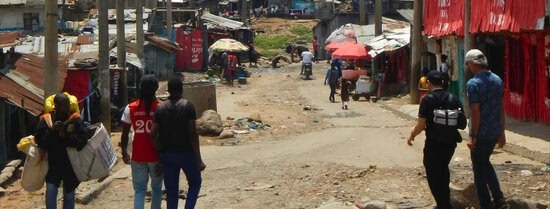
This May, Priya spent a month conducting intensive interviews and focus group discussions in the Mathare informal settlement of Nairobi, Kenya, hosted by the Nuvoni Centre for Innovation Research. Transitioning from academic literature to the physical reality of the settlement was a profound experience for Priya.
"Being in Mathare was nothing like reading about it," she reflects. "The river, the density, the noise, the warmth of people who had been through something enormous and were still just getting on with life - it stayed with me."
Her resulting thesis, titled "Governance in Post-Flood Recovery: Mathare Informal Settlement, Kenya", investigates how community knowledge is systematically filtered, distorted, or entirely lost as it moves up through different tiers of governance.
The "Chinese Whispers" of urban governance
Priya’s analytical framework took shape after a pivotal conversation with Dr. Mbathi at the Nuvoni Centre. Together, they conceptualised how grassroots data mutates as it ascends institutional hierarchies, behaving almost like a game of Chinese Whispers*, reshaped by power dynamics at every stage. Her research highlights a stark reality: recovery policies in the Global South are too frequently designed without the insights of the people navigating the aftermath.
*Chinese Whispers is an internationally popular children’s game where a secret message is whispered from person to person in a line
"One of the clearest learnings so far is how much is lost in translation between what residents know and live, and what eventually reaches institutional decision-makers."

Falling through the cracks: Leonard’s story
Nowhere is this institutional gap clearer than in the story of Leonard Opiyo, a shoe-maker who has lived in Mathare for 25 years. During the devastating 2024 floods, Leonard - who has a disability - had to be physically carried to safety by neighbours and local youth. In the aftermath, the official systems failed him entirely: government registration never translated into financial aid, and state-led demolitions destroyed his business without warning.
Yet, out of this exclusion, Leonard founded the Mathare Persons with Disability Self-Help Group. What began as a personal mission to support children with disabilities who were being hidden away by their families has grown into a self-organised collective of over 50 members. For Priya, Leonard’s initiative represents the core tension of her research.
"[Leonard's] story sits at the exact intersection my research is trying to understand: the gap between what institutions decide and what communities actually live through. The group has grown to over 50 members, entirely self-organised, which says a lot about what communities build when institutions don't show up."
Moving forward
Ultimately, Priya’s work is less about documenting systemic failure and more about charting a proactive path forward for urban climate resilience. By mapping the exact mechanics of this disconnect, her research provides the structural framework needed to help formal institutions shift their power dynamics, move away from rigid systems, and actively integrate the immense adaptability already demonstrated by grassroots leaders like Leonard.
"My hope is that the research [...] contributes, even modestly, toward governance approaches that are genuinely participatory rather than extractive."
- Related content
- Related education


