A new groundbreaking UNEP spotlight report, in which IHS was a core team partner, finds that global temperature rise is set to cross 1.5°C above pre-industrial levels, likely within the next few years. Lucas Snaije, Research Officer at IHS, reflects on what this means for cities.
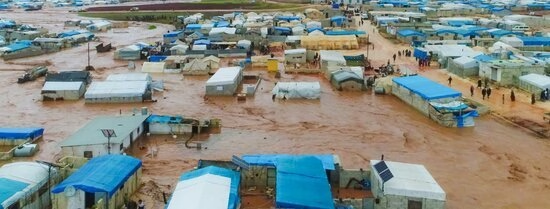
The summer of 2026 tragically underscored the vulnerabilities and fragilities of urban systems worldwide. European cities ground to a halt in the face of unprecedented, extreme heat, which has caused tens of thousands of excess deaths across the continent since May. More recently, more than a million people were moved to safety across eastern China as powerful Typhoon Dolphin made landfall amid fears torrential rain would cause flooding and landslides. The world also witnessed the devastating flash floods that tore through the Nepal-China border, caused by a massive glacier collapse and landslide, which swallowed towns, roads and bridges and caused high loss of life and of livelihoods. These are mere examples of recent, sweeping catastrophes indiscriminately hitting cities and settlements across the globe.

What does overshoot mean?
As global temperature rise gets set to cross 1.5°C above pre-industrial levels, within the next few years, climate risks and impacts will reach dangerous new heights. New research published by the United Nations Environment Programme reveals that limiting long-term harm will require navigating a period of “overshoot, peak and decline”. This would involve rapidly reducing emissions, coping with severe impacts, and moving towards a period of long-term resilience through net-negative emissions and coping with irreversible changes.
This period of “climate overshoot” will create particular challenges for cities and human settlements. Current assessments indicate that 45% of the world’s population live in cities and a further 36% in towns. By the end of the century, 84% of the projected global population will live in urban areas, with the most rapid growth occurring in smaller settlements across Asia and Africa. These conditions emphasise the critical concern of impacts and risks of overshoot pathways for urban systems, and their associated long-term local adaptation planning and policies.
Urban impacts & responses
Temperature overshoot will exacerbate risks to infrastructure, especially for low-lying coastal settlements, low-income cities, and socioeconomically disadvantaged neighborhoods within wealthier cities. Urban impacts will worsen through increased frequency, duration, and intensity of heatwaves; altered spatial and temporal distribution of vector-borne disease risks; flooding; and increased morbidity and mortality from extreme events. These impacts will affect labor productivity and local economies, drive substantial growth in energy demand and associated household costs, and undermine urban development gains and objectives.

Cities are however uniquely positioned to implement effective adaptation and mitigation strategies that offer multiple benefits, such as reducing poverty, creating jobs, improving public services, and enhancing overall quality of life. A wide range of interventions can simultaneously achieve adaptation while helping limit peak warming. For example, increasing tree canopy coverage in cities reduces urban heat islands in heatwaves and promotes carbon storage, and transportation decarbonisation initiatives can reduce emissions while improving resilience to shocks. These strategies need to be implemented in ways that ensure burdens are not passed on to already vulnerable groups, including those whose homes are situated in areas most prone to climate risks and impacts, or whose livelihoods are dependent on carbon intensive activities that would be affected by transition policies.
Some of the most innovative and forward-thinking climate solutions have emerged from cities and communities, and although urbanisation continues to be a major source of greenhouse gas emissions, in many contexts urban emissions per capita are now lower than national averages. A report released to mark the 10 years of the Paris Agreement for example found that over 13,700 cities and regions worldwide are actively advancing climate strategies aligned with the Paris Agreement through city and regional network initiatives, demonstrating measurable progress.

Governing an increasingly uncertain world
A return to global warming below 1.5°C is however far from guaranteed, especially without a meaningful commitment to a fair, managed phase out of fossil fuels. And even if it would be achieved, many urban communities will already be living with irreversible losses and profoundly altered realities, raising difficult questions about justice, power, and who gets to decide our collective future.
Entire communities will be forced to relocate, while others will have to reinvent the livelihoods that once sustained them.
Hard choices will have to be made: what should be rebuilt, which livelihoods can be restored, how communities should be supported for losses and damages. Without dedicated attention to equity dimensions, the effort towards rapid decarbonisation and achieving net-negative emissions will amplify the burdens already placed on the most vulnerable urban dwellers.
Ultimately, the need to respond to exceedance, peak and decline will challenge traditional thinking about city form and function, to respond to both increased existing as well as new unforeseen vulnerabilities. Current forms of governance may no longer be fit for purpose, highlighting a need to explore the implications of this new overshoot reality as early as possible. Even in pathways where temperature reaches a plateau and subsequent decline, non-linear, uncertain effects will still be generated, complicating infrastructure planning and investment, posing significant challenges to achieving equity outcomes for residents.
Such anticipated greater uncertainty in risk patterns will necessitate flexible, adaptive, and responsive approaches to urban decision-making and governance, with a renewed commitment to enhancing adaptation grounded urban climate justice.
- Related content
- Related education
- Related links
- Read the UN Environment Programme (UNEP) report


