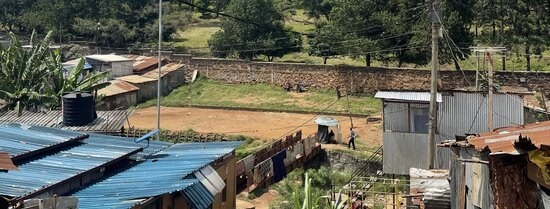
Shaira Chowdhury is an international student from Norway, who specialised in the Urban Environment, Sustainability, and Climate Change track within the Urban Management & Development Master's programme. This year, she had the unique opportunity to participate in the Nairobi Thesis Atelier to conduct fieldwork in the informal settlement of Mathare; an experience she eagerly shared about.
When resilience is not a choice
During the programme, Shaira became interested in topics like public participation in urban governance, gendered climate adaptation, and complex adaptive systems. The Urban Complexity course introduced her to Mathare, where communities continuously organise themselves to cope with environmental shocks despite facing significant structural inequalities.
Rather than viewing resilience as an inherently positive characteristic, the experience prompted a more critical question: what happens when resilience is born out of necessity rather than choice? While communities like Mathare are often celebrated for their ability to cope with recurring floods, this resilience can also reflect the absence of adequate government support. This was the starting point to look into how structural inequalities influence individual participation in climate adaptation initiatives. For her thesis research, she investigated how gender norms shaped women’s meaningful participation in community-based adaptive flood risk management initiatives in Mathare.
The human realities behind climate statistics
On her first trip to an African country, Shaira really enjoyed learning about the culture, trying the food, seeing the wildlife and meeting the kind-hearted people. At the same time, visiting Nairobi also transformed her understanding of climate vulnerability. While scholarly articles describe differential flood vulnerabilities in academic terms, speaking directly with local women revealed how climate-related issues impacted people unequally – especially within the Mathare community. As Shaira puts it,
“It is one thing to do desk-based research on a community like Mathare and read scholarly articles about differential flood vulnerabilities within the community and another thing to have difficult conversations with local women about how the previous floods led to increased domestic violence, mental health issues, unemployment, sanitation issues and caregiving responsibilities.”
Although women played leading roles in helping their communities respond and recover, they often felt their knowledge and priorities were overlooked during flood adaptation meetings.

A commitment to co-creating knowledge
These conversations strengthened Shaira’s commitment to conduct research that amplified the voice of marginalised women and to advocate for more inclusive and equitable urban decision-making processes and spaces. During her fieldwork in Mathare, she conducted multiple interviews with local organisations and facilitated two focus group discussions with local women. She also got to discuss her topic with partners such as Nuvoni Center for Research Innovation, Ghetto Foundation and Slum Dwellers International.
These dialogues became more than a data collection exercise, allowing local stakeholders and community members to shape the research by sharing their experiences and co-creating knowledge about gendered barriers to women’s meaningful participation in flood risk management efforts in Mathare.
Community in action
While doing research on women centered community-based organisations in Mathare, Shaira came across an organisation called MLAHRA ((Mathare Legal Aid and Human Rights Advocacy). Although still a relatively unknown organisation, their intensive work to help Mathare women during past floods was inspiring. They focused on women’s disaster recovery in Mathare by giving them medication, shelter, general aid and conducting meetings to share their flood traumas.
Particularly inspiring for Shaira, was learning that many of the women they gave shelter to after the 2024 floods were able to recover and were trained as caregivers by MLAHRA. Eventually, these women helped other female flood victims during the floods the following year, by providing them psychological support. Their work shows that women are not simply vulnerable victims of floods but also active agents of adaptation, and that resilience and knowledge can be shared and solidified within the community.
Shaira felt that the initiative embodies many of the themes within her research, including gender-inclusive flood adaptation, self-organisation and women empowerment. MLAHRA acknowledges the importance of empowering women to lead in decision-making processes. As the representative of the organisation stated,
“I think women participate, but there are still things that need to be done. I want them to know that nobody can talk on their behalf. We must encourage them to participate and influence policymaking”.
Gender-inclusive policies
Shaira wants her research to show that there is a critical need for more gender-inclusive climate adaptation policies, especially in urban areas where climate disasters have harsher impacts on women. Through her research, she learned that Mathare women possess very valuable knowledge crucial to flood risk management strategies. However, many of these women are simply seen in the community-based flood risk management forums but not heard. She hopes that this research can contribute to meaningful discussions amongst policymakers and organisations within the region.
As floods become more intense and frequent in Nairobi, enhancing pre-existing social issues, Shaira wants to highlight the need for not just an adaptive approach to flood risk management, but also decision-making processes that incorporate marginalised voices.
“Climate adaptation initiatives cannot be considered successful if the most vulnerable to climate disasters are not able to influence the policies that are supposed to protect them.”
- Related content
- Related education


